
Birth Records in Sedgwick County can be retrieved quickly through the official Kansas Office of Vital Statistics portal, where you can perform a birth record lookup by name, date of birth, or parent information. The searchable database includes certified birth certificate copies, informational records, and amended documents, helping you confirm full name at birth, birthplace, and registration number. Whether you need a certified copy for a passport or an informational record for genealogy, the online system guides you step‑by‑step.
When you need to order a certified birth certificate, the Sedgwick County vital records office requires proof of identity and a relationship to the listed person, such as an immediate family member or legal representative. Requests can be submitted online, by mail, or in person, with clear fee structures and typical processing times. If errors appear on the original record, you can also learn how to amend a birth certificate by submitting supporting documentation.
How to Search Birth Records
Birth Records connected to Sedgwick County are part of Kansas’s statewide registration system. A birth-record lookup can narrow a file by the person’s name at birth, date and place of birth, parent names, or a known registration number. Users can also check sedgwick county ks for official county government information. The result helps confirm the listed details and points to the correct path for a certified copy, a non-certified copy, or a record correction. A search listing is not the same as a certified birth certificate.
Official Search Portal: https://www.kdhe.ks.gov/1165/Office-of-Vital-Statistics
Steps to Search
- Open the Kansas Office of Vital Statistics page and select the birth-record search or ordering section.
- Enter the person’s full name at birth and exact date of birth. Use the legal name shown on the earliest available record when a later name differs.
- Add Sedgwick County as the birthplace and enter a mother’s or father’s name when those fields are offered. Use a known registration number instead of name details when one is available.
- Compare each result by full name, birth date, birthplace, parent names, and registration number. This prevents a record with a similar name from being selected by mistake.
- Choose the official path for a copy, correction, or archived record. Review current eligibility rules, fees, documents, and delivery choices before submitting payment.
Sedgwick County Birth Record Jurisdiction
Birth records for births occurring in Sedgwick County are filed through Kansas’s registration process. Local county registrars accept birth registrations, while the Kansas Office of Vital Statistics operates the statewide service for searching and ordering state-certified copies. A record tied to Sedgwick County describes the place of birth, not the place where the person lives now.
That distinction matters during a birth-record search. A Wichita resident may have been born in another county or state, so the birthplace filter should match the birth event rather than a current address. A birth outside Kansas may require a request to the state, county, or foreign authority responsible for that registration.
Birth Record Details and Certificate Types
The details available on a birth record depend on its age and the registration system that created it. Modern records often contain more fields than historical entries, and some fields may have been added through later amendments. Reviewing the type and purpose of the needed copy before ordering helps prevent an unsuitable purchase.
Listed Person and Parent Details
The name field should be treated as the person’s full name at birth, including middle names, prefixes, and suffixes. Parent details help distinguish children with the same name, particularly siblings or children born to the same parents in different years.
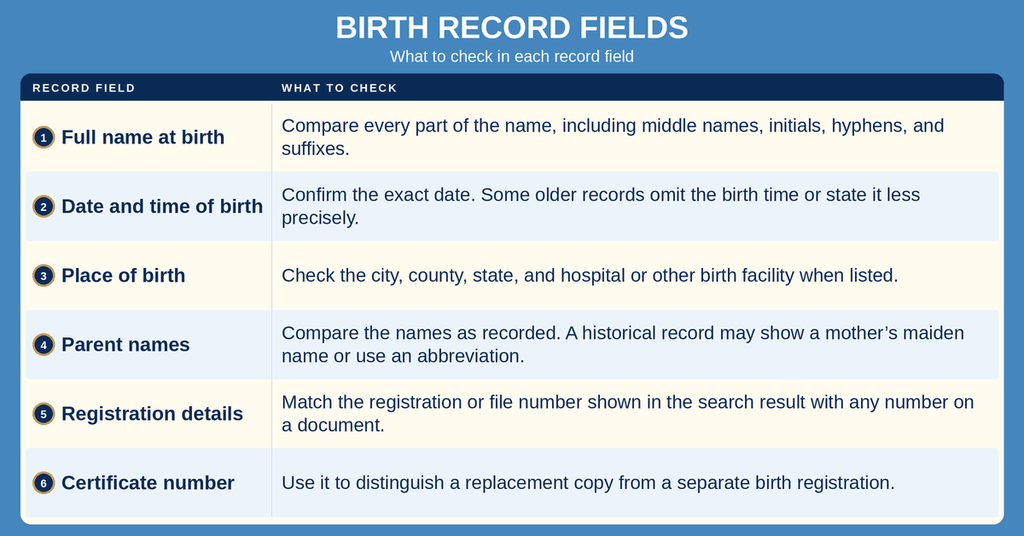
A search result may show only part of the indexed record. A parent’s name or exact birth time can be absent even when the file exists, particularly in an early registration or a file created after a delayed birth report.
Birth Date, Place, and Facility
Place of birth may identify a hospital, city, rural locality, county, and state. The county is often the strongest geographic detail for a Sedgwick County search, yet a hospital name can help when the city or county was recorded in an older way. County boundaries and place names can also differ from the wording used today.
Use the birth facility as a supporting clue rather than the sole search criterion. Historical records may list a home birth, a physician’s office, or a locality without naming the hospital. A facility name does not replace the need for the birth date, parent names, or county.
Certified Copies and Non-Certified Copies
A certified birth certificate is an official copy produced from the state’s registration record. It carries state authentication, such as the registrar’s seal or signature, and serves as legal proof of birth when accepted by the agency requesting it. The registration office retains the permanent file, so an applicant receives a certified copy rather than the original registration record.
A non-certified copy is made for reference or family research. It does not carry the same legal standing as a certified copy and should not be used for a passport, driver’s license, or another purpose that requires legal proof. A replacement certified copy comes from the existing registration and does not create a new birth record or correct an error.
Amended and Delayed Certificates
An amended certificate reflects a legal correction to an existing birth registration. It may carry corrected details for a name, date of birth, birthplace, or parent information after the state approves the required evidence. Ordering another regular certified copy leaves the recorded error unchanged.
A delayed certificate serves a different purpose. It is created when a birth was not registered through the normal filing process, often because the original report arrived late or was never submitted. The request requires supporting proof of the birth and the identity of the parents or other eligible requesters. An amendment and a delayed-registration request use different forms and supporting documents.
Eligibility and Identity Verification
Kansas makes a birth record open to public inspection 75 years after the person’s birth. A file within that period is released only to requesters accepted under state rules, with identity and relationship checks when required. The exact request form controls which documents and relationships qualify.
Authorized Requesters and Family Eligibility
A recent record may be requested by the person named on it, a parent, an eligible family member, or a person acting under legal authority. A request for a deceased person can require proof of death and proof of the family relationship. Records affected by adoption, a parent acknowledgment, or a court order may have separate rules.
These categories describe common requester types, not a promise of approval for every family relationship. The current application may narrow or expand the listed categories. A private genealogy service cannot override a state restriction or issue an official copy without following the same rules.
Required Identification Documents
Government-issued photo identification is the usual starting point for identity verification. The request may also require a relationship document, an applicant signature, or notarization. A current name that differs from the name on the birth record may require marriage, divorce, adoption, or court documents that explain the change.
Check the current form for the required form of each document, such as a certified copy, a photocopy, or an original. Send only the documents requested by the office. Sensitive identity papers should go through the official state process or its linked ordering service, not an unverified genealogy website.
Legal and Representative Authority
A guardian, conservator, attorney, or other authorized representative can act only when the records show authority over the applicant or the person named on the certificate. Residents can also inspect marriage license public information for detailed public documentation. A court order should identify the involved person and the records the representative may obtain. A general power of attorney may not meet the requirements of the birth-record form.
For a minor, the parent or legal guardian normally submits the request. For a deceased person, the applicant may need a death certificate along with documents showing the family relationship. If an agency document grants authority, include every referenced court order or guardianship record so the state office can review the full chain.
Obtaining a Sedgwick County Birth Certificate
Finding a record and ordering a certified copy are separate steps. The search confirms that a registration exists and helps distinguish matching files. The order process then collects the applicant’s details, required documents, fee, delivery choice, and certification request.
Online, Mail, and In-Person Requests
The Kansas office offers request channels for a certified copy. The official page may direct applicants to a secure third-party service for online ordering, so the safest starting point remains the state page shown above.
- Online request: Enter the birth details exactly as they appear in the indexed record, select the certified-copy option, and provide the requester’s relationship, identity documents, delivery choice, and payment. Review the full order summary before submission and save the confirmation number.
- Mail request: Download the current state form, complete it, and include the required identification, relationship or authority documents, and payment. Follow the current mailing instructions on the official page, retain a copy of everything sent, and use a trackable service when available.
- In-person request: Bring the completed form, photo identification, supporting documents, and the accepted form of payment to the office. Staff can review the request, though they may still need time to verify a court record, a delayed registration, or a name change.
Fees, Payment, and Processing Time
The exact fee appears on the current official form or checkout page. A standard certified copy, non-certified copy, amended certificate, and delayed certificate may carry different state fees. An online vendor can add a service charge or delivery charge, which is separate from the state fee. Payment methods also vary by request channel, so the checkout or form provides the controlling choice.
Processing time depends on a complete request and the chosen delivery method. Mail transit, weekends, holidays, document review, and legal verification can affect the wait. A portal estimate applies to that channel and does not cover shipping time. Avoid relying on an old fee table or an estimated completion date from a third-party page.
Application Submission Steps
Start the application with the person’s full name at birth, exact birth date, birthplace, and parent names. Select the requester category that matches the applicant’s relationship to the person named on the record. List any former names only in the section requested by the form, and attach the documents that connect those names to the current requester.
Sign the application as directed and complete any required notarization. Before payment, confirm the copy type, delivery method, mailing address, and contact details. After submission, keep the order number and track the request through the stated channel. A returned application for missing documents can add a new waiting period before certification.
Record Amendments and Corrections
A birth-record correction changes the legal registration after the state reviews evidence. It is not the same as a replacement copy, and it is not used to settle a disputed family relationship without the required legal action. Start with the state’s current amendment or delayed-registration form rather than a standard certificate order.
Fixing Name or Date Errors
A spelling error, such as a transposed letter or an incorrect middle initial, calls for an administrative correction supported by early records. A legal name change is more involved because the requested name must come from a qualifying source, such as a birth record, court order, or adoption decree. The evidence must support the exact change requested.
Date corrections can involve the calendar date, reported time of birth, or place of birth. A later recollection alone may not be enough when the original hospital record, physician’s report, or registration entry gives a different fact. The state office decides whether the evidence supports an administrative amendment or whether a district court order is needed.
Updating or Adding Parent Details
Parent corrections cover an incorrect spelling, a missing parent entry, a mother’s maiden name, or parent information that was added after registration. A marriage certificate can support a parent-name request, but it does not by itself decide every question about legal parentage. An acknowledgment of paternity or a court order may be required when a parent was not listed at registration.
Adding a parent to a birth record does not automatically settle a family dispute. The request must follow the evidence rules for the requested change and may require both parents, an acknowledgment, or a judicial decision. Use the current amendment form to learn which route applies to the specific record.
Supporting Evidence and Review
The amendment application determines which documents qualify. Strong supporting records often connect the birth event, the parents, and the requested correction.
- Hospital, clinic, or physician birth record showing the birth event and stated parents.
- Certified marriage certificate supporting a spouse or parent-name request.
- Certified birth certificates of the parents when they establish parentage or the mother’s maiden name.
- Signed acknowledgment of paternity or a court order establishing legal parentage.
- Adoption decree, guardianship papers, or another court record when the change depends on that decision.
- Census, school, church, or other historical records when supporting a delayed birth registration.
- Death certificate when the amendment process asks for proof that the person named on the record is deceased.
Submit certified copies or originals in the form required by the state. Include the amendment form, the applicable fee, and any required identity or relationship documents. The office retains the existing registration and documents the approved change, so an amended certificate may show that a correction occurred rather than hiding the earlier filing history.
Privacy Rules and Genealogical Use
Privacy rules control who may obtain a recent birth certificate and which details appear in public searches. A record can exist without its full contents appearing in an online index. Restricted files may return no result or show only a limited entry rather than confirm whether a person was born in Sedgwick County.
Confidential and Restricted Records
Records still within the state’s restricted period require an eligible requester and supporting identification. A record affected by adoption, a parent acknowledgment, juvenile circumstances, or a court order may have added limits. A court order may be needed to open a sealed file or obtain a record for a person who falls outside the usual requester categories.
Do not treat a missing search result as proof that no record exists. A confidential file, a delayed registration, a name misspelled in the index, or a record filed under another jurisdiction can all cause an empty result. You can also access license plate guide to review official records. The state office can determine whether a file exists and whether the requester may receive it.
Public Genealogical Indexes
Public indexes can help build a family history before a certified copy is needed. Their coverage and detail vary by source, and an index entry is not a certified document.
- The current Kansas Office of Vital Statistics search covers records available through the state’s current system.
- The Kansas State Archives holds historical birth indexes and registers for earlier years, with coverage that varies by collection.
- County repositories can contain local historical registrations, indexes, or records created before statewide reporting was complete.
- Private genealogy indexes can reveal spelling variants, parent names, and birth locations, but their results require confirmation through an official source.
Historical indexes may list only a year rather than an exact date, omit the mother’s name, or show a surname from a later marriage. Record a citation for each useful entry, including the collection, page, file number, and any source notes. That practice makes family research repeatable and reduces reliance on copied search results.
Passports, Licenses, and Identity Documents
A passport application, driver’s license request, Real ID request, or other legal purpose normally calls for a certified copy. A non-certified research copy does not carry the same legal standing. The requesting agency sets the accepted form and may require a full certified certificate with the state’s authentication.
A birth certificate can support an identity request, but it may not settle a separate citizenship question. Check the passport or licensing agency’s current document list before ordering. If a full certified copy is required, ordering one official copy through the state process is safer than buying several non-certified printouts.
Record Accuracy and Search Problems
A failed birth-record search often reflects a small data difference rather than a missing registration. Name spelling, county boundaries, delayed registration, and restricted records cause many empty or confusing results. Work through one change at a time so the search history remains clear.
Spelling Variations and Missing Entries
Parents sometimes spelled a child’s name differently on the hospital record, birth certificate, school record, and family Bible. Initials, nicknames, omitted middle names, and surnames changed through marriage can also separate otherwise matching records. Search by date and parent information before removing the name field.
Older records can contain gaps in the time of birth, facility, mother’s maiden name, or father’s name. A delayed registration may carry a date based on a later family account rather than the original filing date. Compare early records from the birth, parents, and early childhood years before requesting a correction.
Multi-Jurisdiction Record Delays
The county of birth controls the primary Kansas search. A hospital near a county line can create confusion if an address was recorded by the hospital’s location rather than the residence or birth-event location. Search the adjacent county and compare the hospital name, date, and parent details when a direct Sedgwick County search fails.
A record may have been registered in another state or country even when the family later lived in Sedgwick County. A birth aboard a ship, military facility, foreign hospital, or tribal jurisdiction can involve another agency. Ask the birth jurisdiction for its current request process rather than treating the Kansas result as a complete national search.
Unlocated Birth Record Resolution
Use the table below to separate common search failures from actual record corrections. Preserve the exact name, date, location, and parent details used in each attempt.
If a birth record does not appear, remove search filters, try spelling variations, and confirm the county where the birth occurred. If multiple results appear, compare the birth date, birthplace, parent names, and registration numbers to identify the correct record.
For incorrect names or dates, follow the state’s official amendment process. Missing parent details may require historical records or legal evidence. Restricted records may not appear in public searches. If the birth occurred outside Kansas, contact the relevant registration authority. For unregistered births, ask about obtaining a delayed birth certificate. If duplicate entries appear, verify the registration numbers and dates with the state office before ordering a copy.
If the current state search produces no usable file, continue with the Kansas State Archives and the appropriate county historical collection. Save the search terms, date, and parent names used in each location. That record helps a later requester or office staff narrow the file without repeating the same unsuccessful search.
Contact Information
Use the following details for questions about a Sedgwick County birth-record search, certified-copy order, amendment, or office visit. The current official page remains the best source for forms, ordering links, and current fees.
Frequently Asked Questions
Find quick answers about locating, requesting, and fixing birth records in Sedgwick County, Kansas.
How to search Sedgwick County birth records online?
Start at the Kansas Office of Vital Statistics website and open the birth records search portal. Enter the full name at birth, date of birth, or parent names. The system narrows results to matching entries in the statewide database. Review the summary to confirm details before requesting a certified copy. Online searches show only index information; they do not issue certificates. If you cannot locate a record, verify spelling or try alternative name variations.
Who can request a Sedgwick County birth certificate?
Only the person named on the record, a legal parent, or an authorized representative may request a certified copy. Immediate family members such as siblings may obtain an informational copy with proper identification. Legal representatives need a power of attorney or court order. Unrelated individuals must show a documented need, like a court case, to receive any version of the record.
What info is needed for a birth certificate request?
You will need the full name at birth, date of birth, place of birth, and parent names. Include the registration number if known. A valid photo ID, such as a driver’s license or passport, must accompany the request. For non‑certified copies, a relationship statement may be required. Fees vary; check the current rate on the official website before submitting the application.
How to correct an error on a Sedgwick birth record?
Submit a birth certificate correction form to the Kansas Office of Vital Statistics. Attach supporting documents like a marriage certificate for a name change or a hospital record for a date correction. The request must be signed by the person named on the record or an authorized parent. After review, the office issues an amended certificate and updates the online index.
Where to find old Sedgwick County birth records?
Historical birth records are stored at the Kansas State Archives. Contact the archives by phone or email to request a copy. Provide the name, birth year, and any known parent information. Some older records may also be available through genealogical websites that partner with the state’s vital records office. Fees and processing times differ from standard requests.